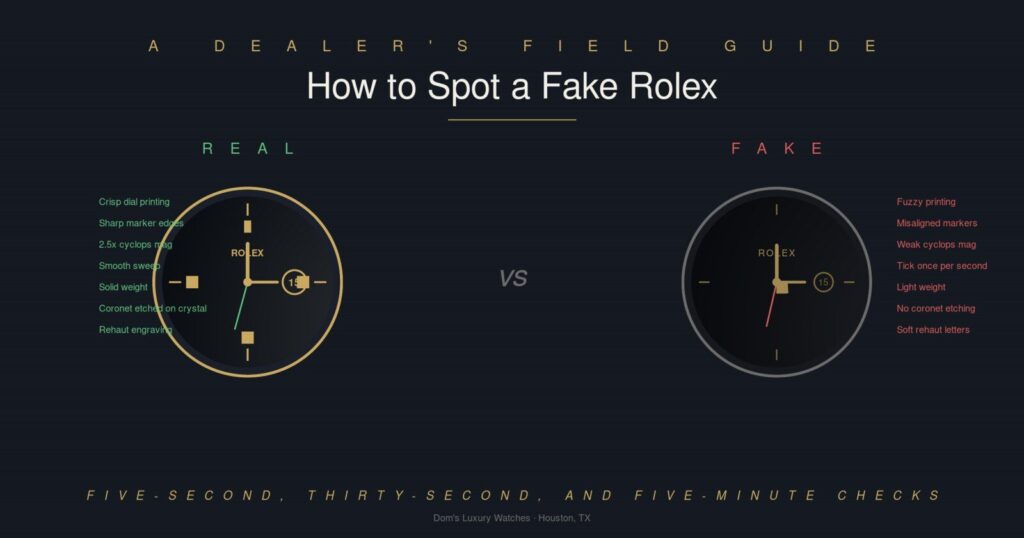
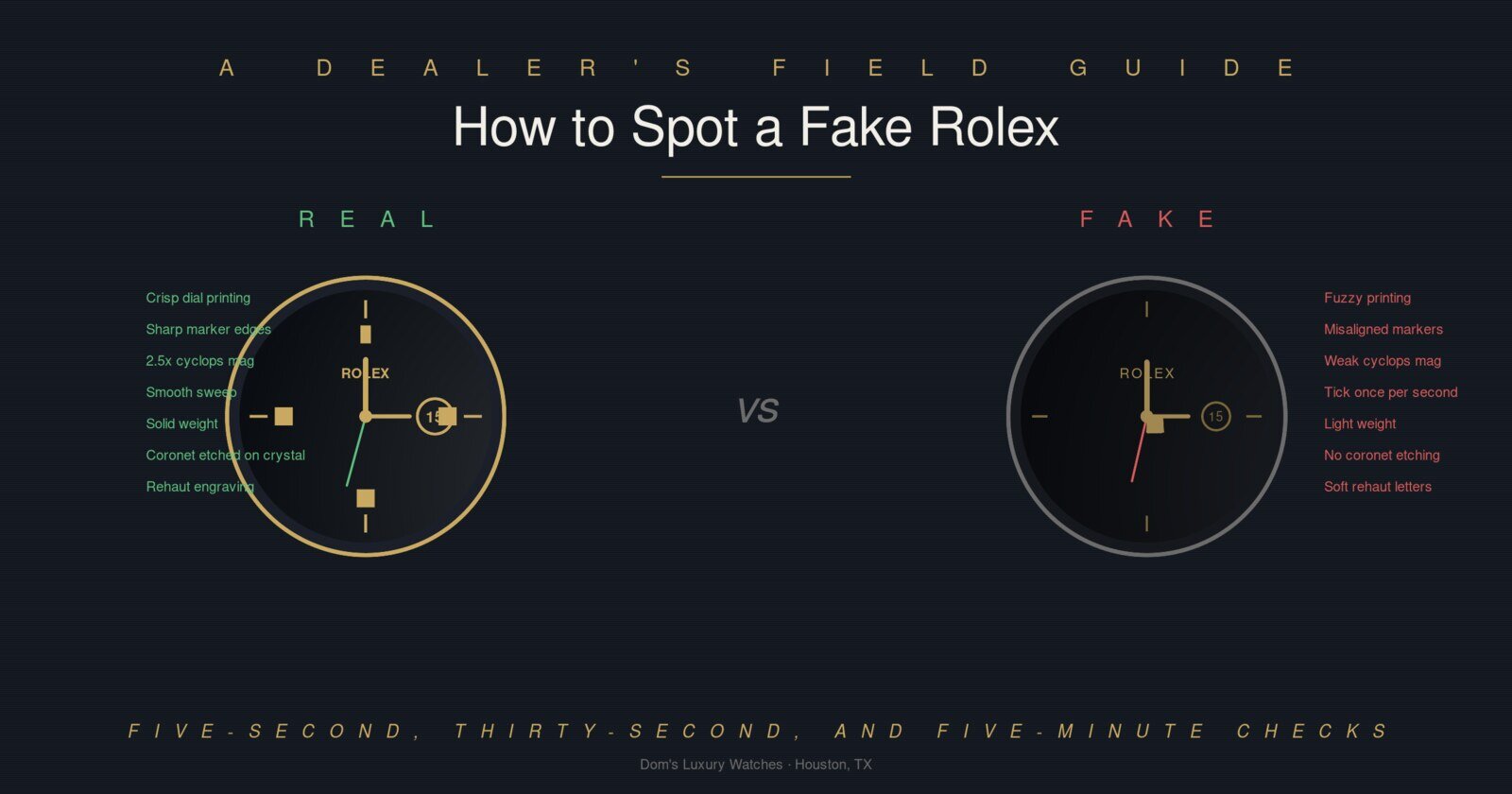
To spot a fake Rolex, start with four five-second checks: a genuine Rolex feels heavy for its size, its second hand sweeps smoothly (about eight ticks per second, never one tick per second), its dial printing is razor-crisp with evenly spaced markers, and its date magnifies 2.5× under the cyclops lens. Fail any of these and you likely have a fake. Passing them isn’t proof — today’s “super clones” clear the quick checks, so the reliable tells move to the rehaut engraving, the micro-etched crystal coronet, case-finishing transitions, and the movement, which needs a brand-specialist watchmaker.
The five-second test most fakes still fail
When a watch lands in front of me and I suspect it isn’t real, the first decision happens fast. I’m not running a checklist in my head. I’m looking at the dial, listening for the second hand, feeling the weight in my palm, and looking at how the bracelet sits on the wrist. That’s the five-second test. Almost every poor counterfeit fails one of those four checks before I’ve even reached for a loupe.
The trouble is that the better counterfeits, the so-called super fakes, have closed that gap considerably. Today’s worst-case scenario isn’t a $200 swap-meet replica that looks obviously wrong. It’s a $1,500 super clone that passes the five-second test and forces you to dig deeper. This guide walks you through how I dig deeper, in the order I’d actually do it if you handed me a Rolex right now and asked whether it’s real.
If you’re holding a watch you suspect is a fake, work through this guide in order. Some checks you can do with your eyes. Some need a loupe. Some you’ll need a watchmaker for. The order matters: the cheap, quick checks come first because if a watch fails at the dial or weight stage, you’ve already got your answer.
First, the obvious caveat
Nothing in this guide is a substitute for professional authentication on a watch you’re about to pay real money for. The super-clone market has gotten good enough that even seasoned dealers occasionally get a piece they need a second opinion on. For our authentication, we use brand-specialist Houston watchmakers who’ve spent 20 to 30 years inside the specific calibers they’re inspecting. If you’re considering a serious purchase, our sourcing and authentication process explains how that works.
This guide is for the moment before that. It’s for when you’re holding a watch and trying to figure out whether it’s worth the cost of a professional opinion, or whether the answer is already obvious.
The five-second checks (no loupe needed)
These are the things I look at first. They’re the cheapest, fastest signals, and they catch most low-tier fakes immediately.
The weight in your hand
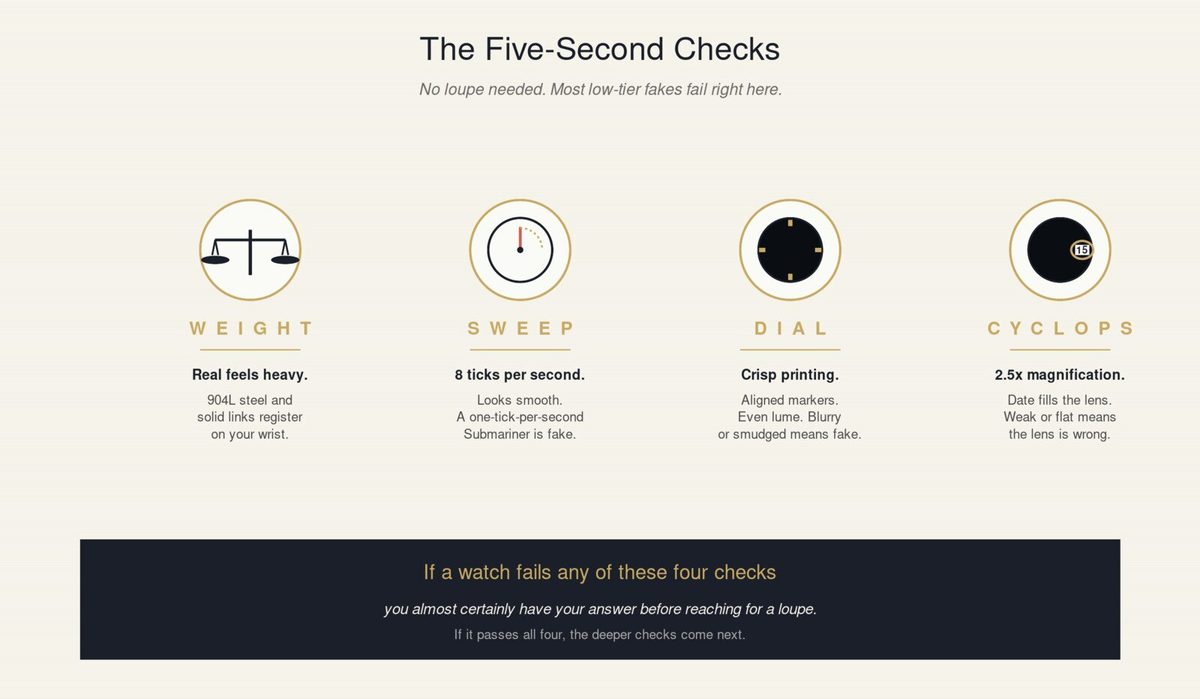
A genuine Rolex feels heavier than it looks. The case is solid metal, usually 904L stainless steel or 18k gold, and the bracelet is dense. When you pick up a real Submariner, your wrist registers the weight before your eyes register the watch. A cheap fake feels light, sometimes alarmingly so. The metals are thinner, the bracelet hollow, the case sometimes a coated alloy that gives itself away on contact.
This isn’t a definitive test on its own, because better counterfeits use weighted cases to mimic the heft. But if a “Rolex” feels noticeably light, you almost certainly have an answer already.
The second hand sweep
Watch the second hand for ten seconds. A real Rolex mechanical movement runs at 28,800 vibrations per hour, which translates to a second hand that appears to sweep smoothly rather than tick once per second. It isn’t perfectly fluid. Look closely and you’ll see eight subtle ticks per second. But from a normal viewing distance, the motion reads as continuous.
A cheap quartz fake ticks once per second, the way a basic battery-powered watch does. That alone disqualifies the watch from being a real Rolex outside of the small handful of historical quartz references. A better fake will use a mechanical movement that sweeps similarly to a real Rolex, which is why this check isn’t conclusive on its own. But if you see one-tick-per-second motion on a watch claimed to be a modern Submariner, Datejust, or Daytona, you have your answer.
The dial under good light
Hold the watch under a strong lamp and look at the dial. A real Rolex dial is one of the most precisely manufactured surfaces in consumer watchmaking. The printing is crisp, the markers are evenly spaced, the lume is applied without smearing, and the font is consistent. The fakes that fail the five-second test usually fail here. Look for:
- Lettering that looks soft, fuzzy, or uneven
- Crooked or misaligned hour markers
- Lume that’s blobby, asymmetrical, or applied past the edges of the markers
- The Rolex crown logo at 12 o’clock that looks slightly off-shape or off-center
- Text that doesn’t match the reference’s known dial layout
The super clones have largely solved the dial problem, but the cheap and mid-tier fakes still betray themselves here.
The cyclops magnification
Most modern Rolex models with a date have a cyclops lens, a small magnifying bubble over the date window. On a real Rolex, that lens magnifies the date 2.5 times. The date should fill the window cleanly and read large. On a fake, the magnification is often weaker or absent, and the date can look the same size whether the lens is there or not. It’s a small detail but quick to check.
The thirty-second checks (loupe and good light)
If the five-second checks all pass, the watch deserves a closer look. This is where you need a 10x loupe and a strong, raking light source.
The micro-etched crown at 6 o’clock
Since 2002, Rolex has laser-etched a tiny crown logo into the sapphire crystal at the 6 o’clock position. It’s almost invisible to the naked eye. Under a loupe with light at the right angle, you should see a crisp, perfectly proportioned coronet. Counterfeits attempt this etching but the execution is usually crude. The edges look rough, the proportions slightly wrong, the placement off.
If you see no etching at all on a modern reference that should have one, that’s a strong red flag. If you see one but it looks soft or oversized, also a red flag.
The rehaut engraving
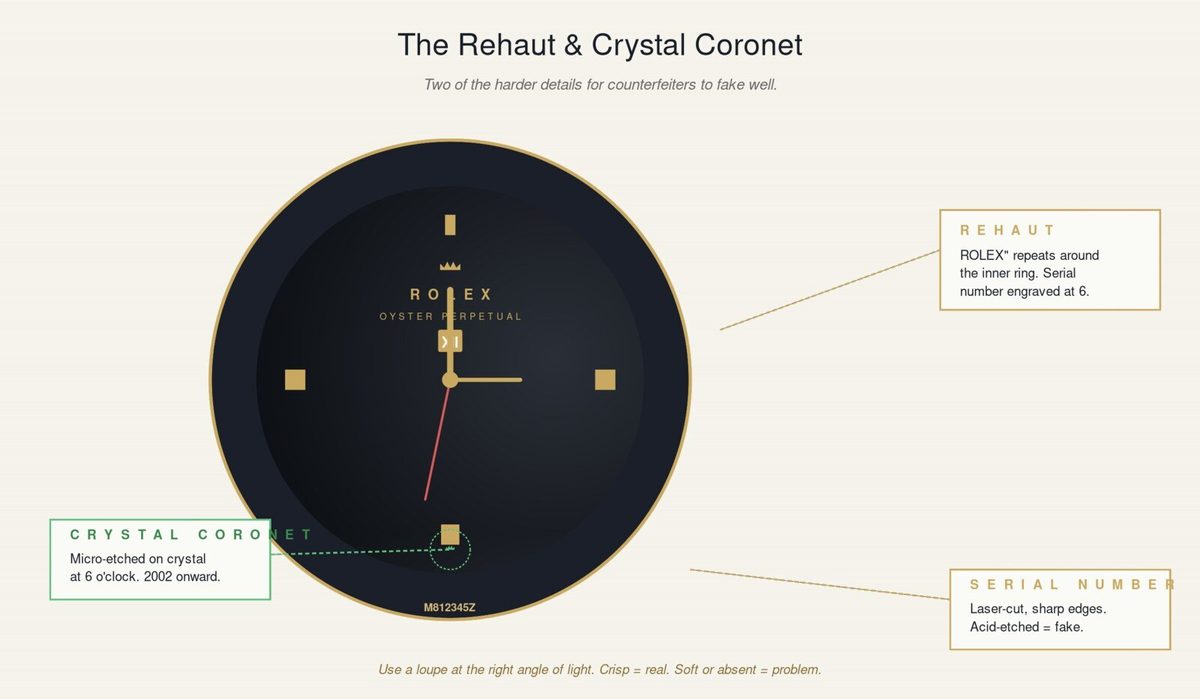
The rehaut is the inner ring between the dial and the crystal. Since around 2005, Rolex has engraved “ROLEX ROLEX ROLEX” around the rehaut, with the serial number visible at 6 o’clock. On a real watch, the engraving is sharp, deep, and laser-precise. On a fake, the lettering often looks shallow, uneven, or printed rather than engraved.
This is one of the harder details for counterfeiters to fake well, which makes it one of the more useful checks on modern references.
The serial and reference number engraving
The serial number on a modern Rolex appears on the rehaut at 6 o’clock. The reference number appears at 12 o’clock. Both are laser-etched with sharp, clean edges. The serial should look like it was cut into the metal, not stamped or acid-etched. On older pre-2005 watches, the engravings appear between the lugs at 6 and 12, hidden when the bracelet is attached. Same standard: sharp, clean, deep. If you can read the serial number, write it down.
The clasp engravings
Open the bracelet and look at the inside of the clasp. The Rolex coronet, the model designation, the steel grade, and various codes should be crisply engraved. Cheap fakes often have rough, shallow, or misaligned clasp engravings. Better fakes do this well, so it’s a supporting signal rather than a deciding one.
The five-minute checks (need patience and reference photos)
Pull up reference photos of the exact model and year you think you’re looking at. A reliable source is the Rolex official website or a well-established collector forum. Compare the watch in your hand to the reference photos in detail.
Reference and configuration consistency
Every Rolex reference number corresponds to a specific design. The Submariner reference 116610LN, for example, has very specific dial markers, hand styles, bezel insert font, and bracelet construction. If you compare your watch to the official reference photos and something looks subtly wrong — the wrong shape of the markers, an unusual bezel font, an incorrect crown guard angle — that’s a serious problem. This is also where “Franken” watches (built from a mix of real and replaced parts) get exposed.
Bracelet originality
The bracelet on a real Rolex is engineered to specific tolerances. The links should feel solid, not hollow. The articulation should be smooth and even, not loose or sloppy. The end links should fit the case lugs precisely, with no gap or wiggle. The clasp should snap closed with confidence. Hollow links, sloppy fit, loose articulation, or a weak clasp closure are all warnings — not automatic proof of a fake, since aftermarket bracelets exist and old bracelets stretch, but signs that something needs explaining.
Case finishing under magnification
Rolex case finishing is famously controlled. Where the case is brushed, it should be evenly brushed in a clear direction. Where it’s polished, it should be mirror-smooth without machining marks. The transition between brushed and polished surfaces should be sharp, not soft. Lugs should have clean defined edges, not rounded-off softness from sloppy polishing. Replicas often get the transitions wrong.
What to do if you suspect a fake
Suspicion isn’t proof. Even with everything in this guide, some super clones will pass these checks. If you’re about to spend serious money on a watch that has cleared the visual checks but you still feel uncertain, the next step is a professional opinion.
- Don’t pay until you’ve had it authenticated. If a seller refuses to allow professional authentication before sale, walk away. A legitimate seller will understand the request.
- Get the serial number checked. Public databases can flag stolen or recovered watches by serial. They won’t confirm authenticity but they can flag a problem.
- Take it to a brand-specialist watchmaker, not a general jeweler. Opening the caseback and inspecting the movement is where most super clones finally fail. A brand specialist sees things a generalist won’t.
- Look at the seller’s transparency. A written condition report, a return policy, and a willingness to allow inspection before payment are all positive signals. Reluctance on any of them is a warning.
If you’ve worked through this guide and you’re still uncertain, that’s exactly when our sourcing and authentication service is useful. We’d rather you buy a real watch from anyone than buy a fake from us by accident. You may also want our companion guide, How to Tell If a Rolex Is Real: 12 Verification Checks, for a systematic reference-by-reference walkthrough.
Frequently asked questions
What is the most commonly faked Rolex?
The most heavily counterfeited Rolex references are the ones with the strongest brand recognition and resale demand: the Submariner, Datejust, Daytona, GMT-Master II, and Day-Date. The same models that drive legitimate demand also drive counterfeit production.
How does a real Rolex tick?
A real Rolex mechanical movement runs at 28,800 vibrations per hour. The second hand appears to sweep smoothly from a normal viewing distance, with eight subtle ticks per second visible only under close examination. It does not tick once per second the way a basic quartz watch does.
What does the back of a real Rolex look like?
Most Rolex casebacks are smooth, solid steel or precious metal with no engravings or exhibition window. A small number of vintage references and limited editions are exceptions, but the default is a clean, unmarked, opaque caseback. An exhibition caseback on a watch sold as a modern mainstream Rolex is a strong red flag.
Can I tell if a Rolex is fake just from a photo?
Sometimes. Poor counterfeits reveal themselves through dial imperfections, off-center markings, or wrong fonts that show up in photos. Better ones don’t. If buying remotely, request multiple high-resolution macro shots of the dial, rehaut, clasp, and caseback, and compare every detail to official reference photos. A seller who refuses detailed photos is a warning sign.
Are super clones really that hard to spot?
The best super clones are difficult enough that even experienced collectors occasionally need professional verification. They typically pass the five-second test on weight, dial, and movement sweep. Where they still fail is usually the rehaut engraving quality, the micro-etched crystal coronet, the case-finishing transitions, and the internal movement details visible only with the caseback open.
What should I do if I think the Rolex I already own is fake?
If you bought it recently from a dealer, contact them with your specific concerns and request a verification process. If they refuse, that’s its own answer. If it came from a private sale or long ago, have it inspected by a brand-specialist watchmaker. Selling a counterfeit is illegal, so a fake’s commercial value is essentially zero — but knowing for certain lets you make informed decisions.
Key takeaways
- Most poor counterfeits fail one of the five-second checks: weight, second-hand sweep, dial quality, or cyclops magnification.
- Modern Rolex watches from 2002 onward have a micro-etched crown on the crystal at 6 o’clock; from ~2005 the rehaut is engraved with the serial at 6 and “ROLEX” repeating around the ring.
- Super clones have closed the gap on visual checks — the remaining tells are usually engraving quality, case-finishing transitions, and movement internals.
- Suspicion is not proof. For serious money, professional authentication from a brand-specialist watchmaker is the only reliable safeguard.
- A legitimate seller will allow authentication before payment, provide condition disclosure, and offer recourse if the watch is misrepresented.
Need a real Rolex you can trust?
If you’ve worked through this guide and decided to walk away from a deal — or you’d rather find the right Rolex without authenticating one yourself — we can help. We source and authenticate pre-owned Rolex pieces through our Houston-based brand-specialist watchmaker network. Tell us what you’re looking for and we’ll start the search.
Contact Dom’s Luxury Watches to start the conversation →